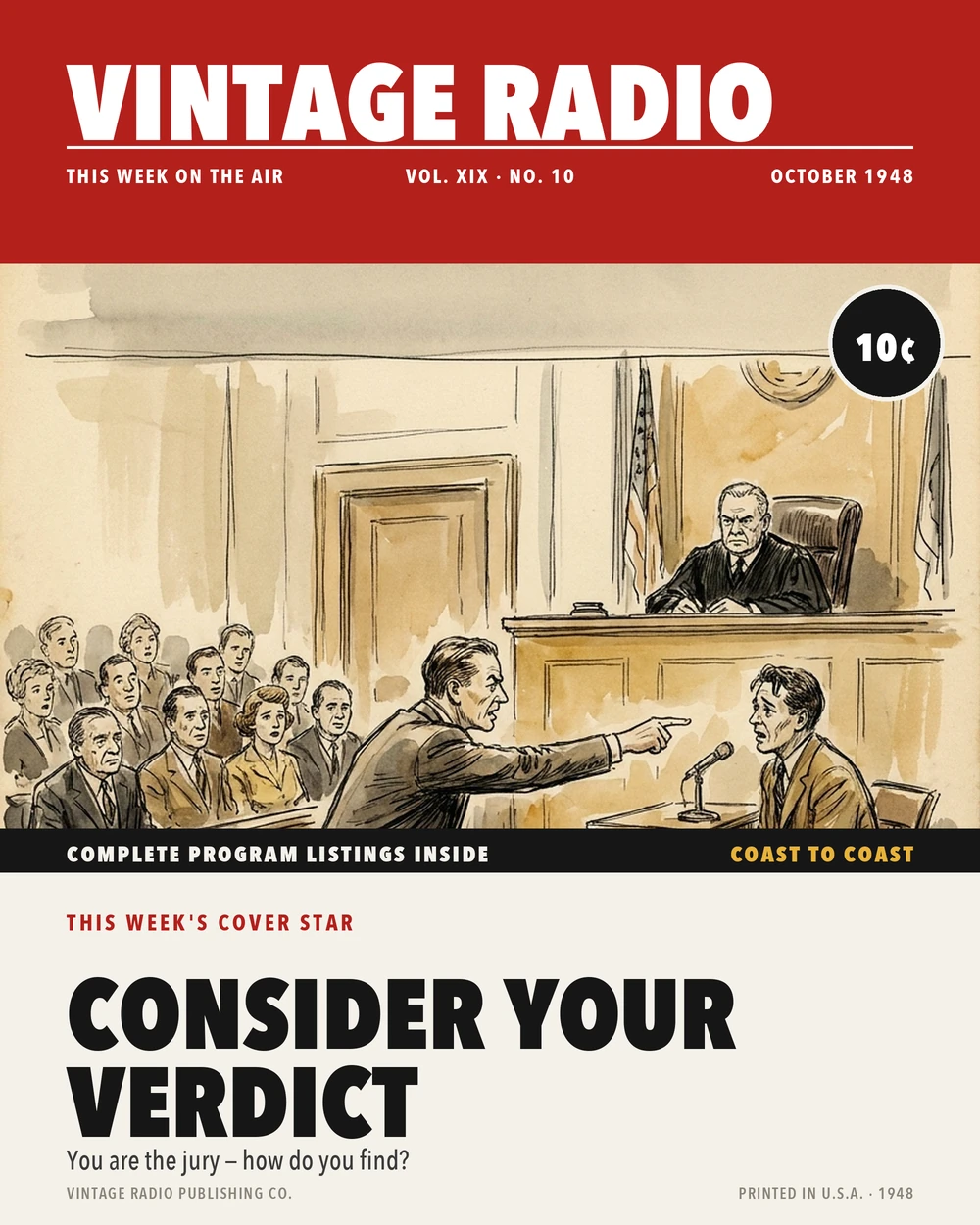
Consider Your Verdict
The Jury Is You
Consider Your Verdict had a simple but effective premise, captured in its own tagline: "it's time for you to take your place on the jury." Each episode presented a different court case, walked listeners through the evidence and testimony, and left them to weigh the outcome for themselves. That format — part drama, part civic exercise — gave the show a quality that straight detective series couldn't match. The listener wasn't following a hero through a case. The listener was the jury.
The series was created and produced by Michael Silver at CRC Studios in Johannesburg and broadcast on Springbok Radio, South Africa's nationwide commercial station that operated in both English and Afrikaans. It began in 1954, initially airing on Tuesday evenings, and ran for over thirty years — ending in December 1985 when Springbok Radio itself went off the air.
How It Was Made
What made Consider Your Verdict unusual wasn't just its courtroom format — it was the production method. Scripts were only written for the judges, lawyers, barristers, and police officers. Everyone else — the witnesses, the defendants — was given only a basic outline of the case and told to improvise. Characters paused, stumbled over their words, and contradicted themselves the way real witnesses do. The effect was striking. The program sounded less like a drama and more like an actual proceeding.
The show used a revolving cast to populate its different cases, which meant no recurring detective or investigator anchored the series week to week. Each episode title followed the same pattern — Case Against Arthur Wheeler, Case Against Rosa Harris, Case Against Phillip Barker — and that consistency reinforced the courtroom-as-institution feel. The cases were the show. The format was the star.
The series aired four days a week with a Sunday recap, a demanding production schedule sustained across three decades.
Where It Came From
Consider Your Verdict was loosely based on an American series called Famous Jury Trials, which had also aired on Springbok Radio before the South African production took its place. When Famous Jury Trials ended its American run in 1949, Silver developed the local version a few years later — rooted in South African settings and cases rather than imported American material. The shift made the show's moral questions immediate and local rather than borrowed from another country's legal culture.
The series ran long enough that surviving recordings document episodes from 1966 and 1968, well into the middle stretch of its run. Twelve recordings are known to survive, totaling just over five hours of audio — a modest sample from a program that aired hundreds of times over thirty-one years.
What It Left Behind
Consider Your Verdict is remembered as one of the signature dramas of the Springbok Radio era, alongside Squad Cars and Taxi. Its longevity alone sets it apart. A show that keeps its audience returning four nights a week across three decades solved something — some combination of format, craft, and subject matter that kept the jury box feeling worth sitting in, year after year.